back to all posts
August 18, 2026

How Widener University partnered with CollegeVine to turn disconnected systems into a summer catch-up plan for its students

Read the full story

Widener University runs on more than 100 systems. Transcripts, degree audits, transfer credit, and course sections all live in different places, often with different names for the same thing.

Untangling the data before the agents could work

Widener's partnership with CollegeVine started with two agents: Todd for graduate recruitment, and Taylor for the campus one-stop. Getting them right meant confronting what was underneath them.

"We have 100 plus systems at our campus, resulting in a highly decentralized organization," said Joseph Howard, Ed.D., VP for Enrollment and Technology at Widener University. "Our data fragmentation and data hygiene issues are real and pervasive."

For the summer catch-up plan, CollegeVine focused on one system: the student information system holding Widener's transcripts, degree audits, transfer credit, and course data. CollegeVine normalized those records into one shared structure and layered in Widener's own rules: the exact course sequences, prerequisites, and corequisites each major requires. Everything resolves into four things the system can reason about: a person, a course, a program, a requirement.

From a progress report to a plan

That common structure turned a process that used to take months, reconciling what a degree requires against what a student has actually completed, into one that takes minutes.

For every student, the system checked three things: do they still need this course, can they actually take it, and can they register for it right now. Only students who cleared all three got a recommendation.

For campuses where the data already has the answer

The ingestion work only has to happen once. Next summer, the same system runs across Widener's entire undergraduate population, and the same data layer will support curricular complexity scoring, flags for course combinations students struggle with, and self-serve insights for deans.

"Aside from practices that simply identify at-risk students, we've started to think more systematically and structurally," Howard said. "Where are the institutional roadblocks that hamper student progress? We're excited to see how AI might help illuminate such challenges."


Read the full story

Turn insight into action with tasks

How Molloy University partnered with CollegeVine to use AI for transcript processing, giving 835 hours back to its operations team

How Barry University partnered with CollegeVine to build the foundation for consistent decisions and earlier interventions, powering its degree audit and a 24/7 student helpdesk

How Widener University partnered with CollegeVine to turn disconnected systems into a summer catch-up plan for its students

Build a course schedule you can actually defend

Changelog: June 2026

How Northern Arizona University partnered with CollegeVine to replace event-by-event outreach with an agent that accompanies 11,000 visiting families a year

How New Jersey Institute of Technology partnered with CollegeVine to answer students faster and build one view of the student record

EDUCAUSE Demo Day | How CollegeVine's ontology powers AI across higher ed

6 AI use cases gaining traction in higher ed operations

The VineDown: How to make enrollment management cool again | Reggie Hill @ UMSL

Introducing CollegeVine’s free IPEDS Insights Agent

Before you deploy an AI agent, ask yourself these 3 questions

How your enrollment agent turns one question into a deployed app

CollegeVine CEO Zack Perkins chats with Mickey Baines about how AI is changing enrollment analytics

Jessica Bohan and Mickey Baines talk about how higher ed teams can use AI agents

The VineDown: The subprime student loan crisis no one is talking about with New America's Stephen Burd

The VineDown: The CFO playbook for enrollment leaders with Kevin Dyerly at University of Redlands

The VineDown: Why most enrollment leaders are optimizing for the wrong number with Dr. John G. Haller

The VineDown: From basketball coach to NACAC president: Todd Rinehart on recruiting with your soul intact

The VineDown: The transcript is broken: Kevin Mathes on why admissions is running on outdated infrastructure

The VineDown: How UCLA's head of admissions processes 170,000 applications a year | Gary Clark

The VineDown: How brutal honesty built five straight years of enrollment records | Jenny Sawyer @ Louisville

The VineDown: How to expand the definition of student success with the admissions leader @ UT Austin

AI in Student Affairs?

From CBOs: The Financial Outlook for Higher Ed Report

The Campus Tech Team's Views on AI

How Finance Leaders Are Charting a Strategic Path for AI in Higher Ed

Will AI reshape the value proposition of Higher Ed?

Establishing a human baseline for transcript reading accuracy

Unlocking AI Transformation: How Finance Leaders Are Shaping the Future of Higher Ed

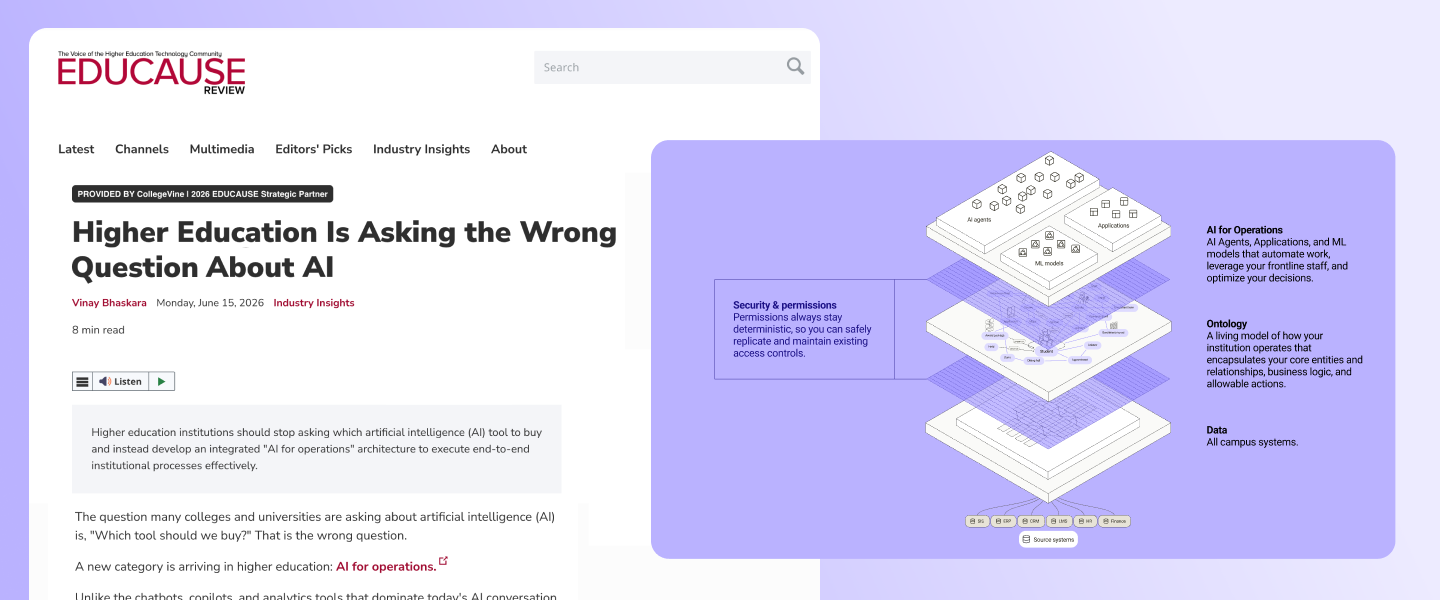
Higher education is asking the wrong question about AI

Critical insights at the speed of thought

Know your feeder schools before travel season

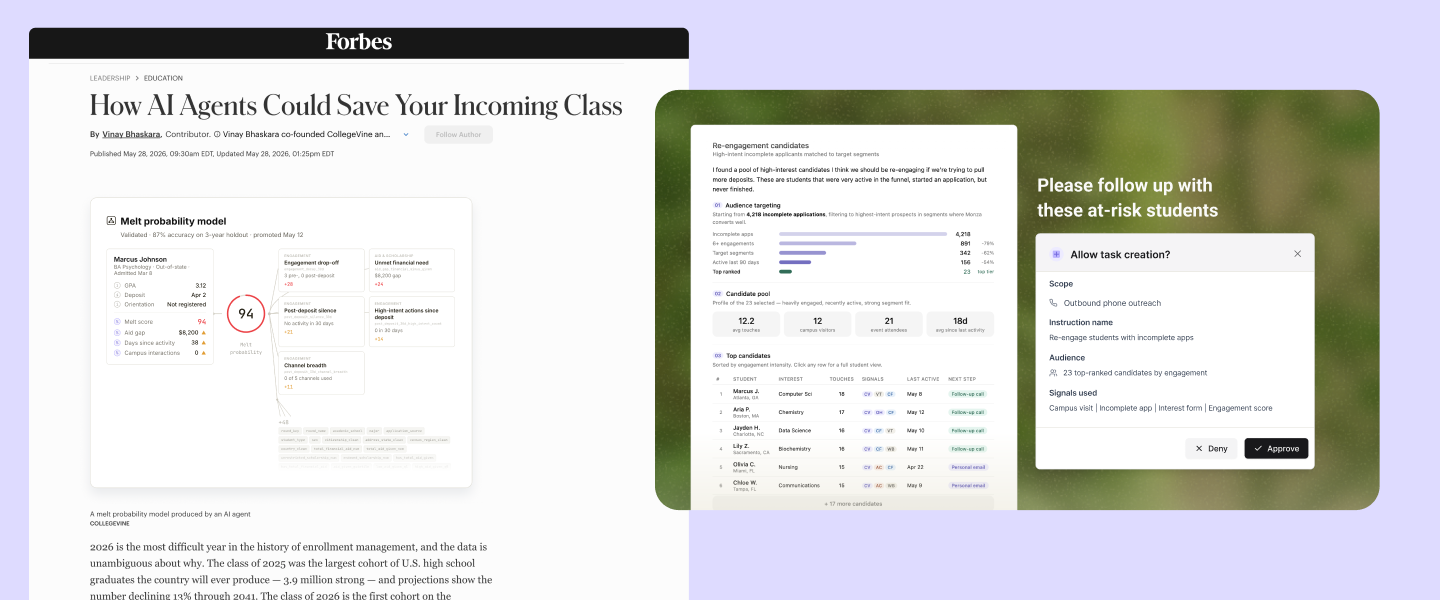
How AI agents could save your incoming class

Your enrollment briefing, ready before you sit down

How your enrollment agent learns your CRM

Introducing the communications audit

Getting ahead of summer melt

Previous Article
Next Article