
At New Jersey Institute of Technology, a large share of students are first in their family to navigate college, close to a quarter are international, and many work a job alongside a full course load. Whatever hours are left for dealing with the university come at the end of the night.
"Every student, whether we like it or not, has one story," says Marybeth Boger, SVP of Student Affairs and Dean of Students at NJIT. "But the way institutions have operated for years is holding that story as fragmented data all over the place, and then we ask the student to carry it from office to office for us."
NJIT has spent the past several years closing that gap with CollegeVine, in three phases so far.
Answering the same day someone asks
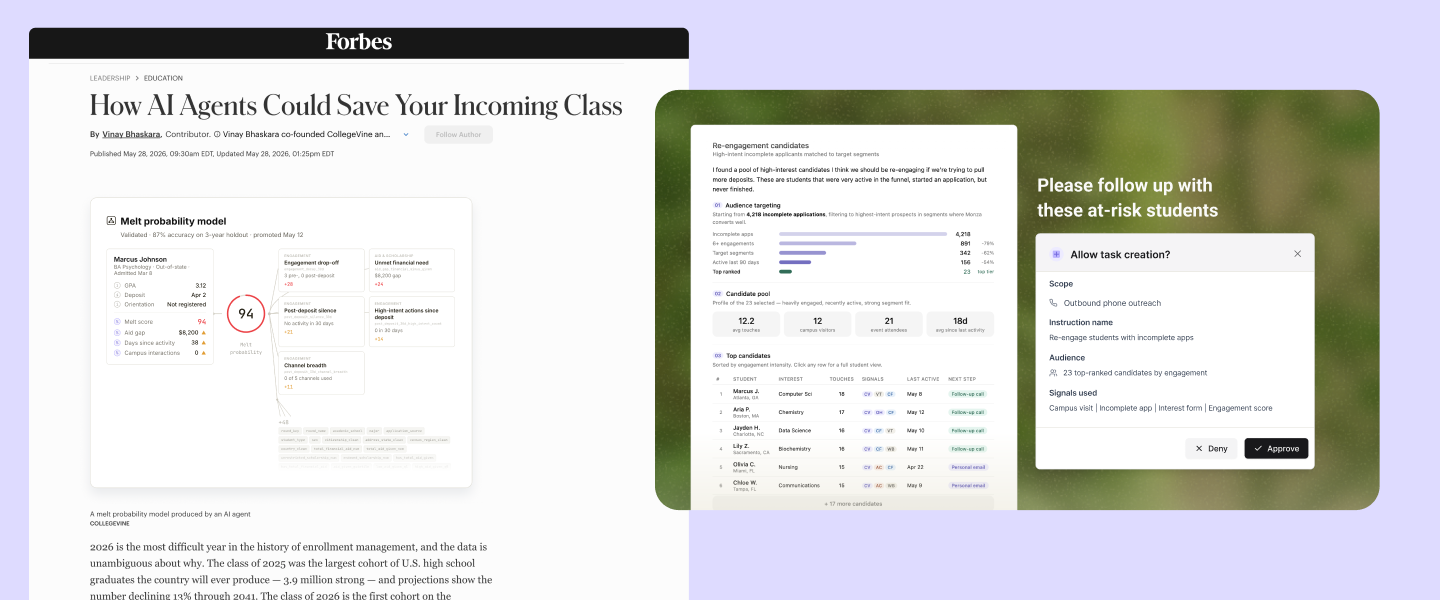
A prospective student named Steve called admissions to ask whether NJIT was serious about artificial intelligence. NJIT answered with Sir Highlander, an AI recruiter built alongside CollegeVine and trained on the university's programs and voice, which wrote back the same day naming the exact program Steve had asked about and the research cluster he'd use as an undergraduate. Steve enrolled, and by the end of the 2025-2026 academic year, Sir Highlander had sent 33,990 of these emails at a 32.7% open rate.
Being there when no office is open
Charlie started as a narrower idea, an AI advisor for academic questions, until NJIT and CollegeVine found students were really asking about housing, billing, registration, and FAFSA. So the team rebuilt it into an AI One Stop that answers in roughly 50 languages and never closes, reaching the students who don't have an advisor who already knows their name. "There's a whole group in the middle who belong to no cohort," Boger says. "They have the question sitting right here, and it never comes out of their mouth." In its first year, Charlie engaged 1,789 first-year students at a 49.5% response rate, often leading them into a conversation with a human rather than replacing one.
One student, five fragmented views
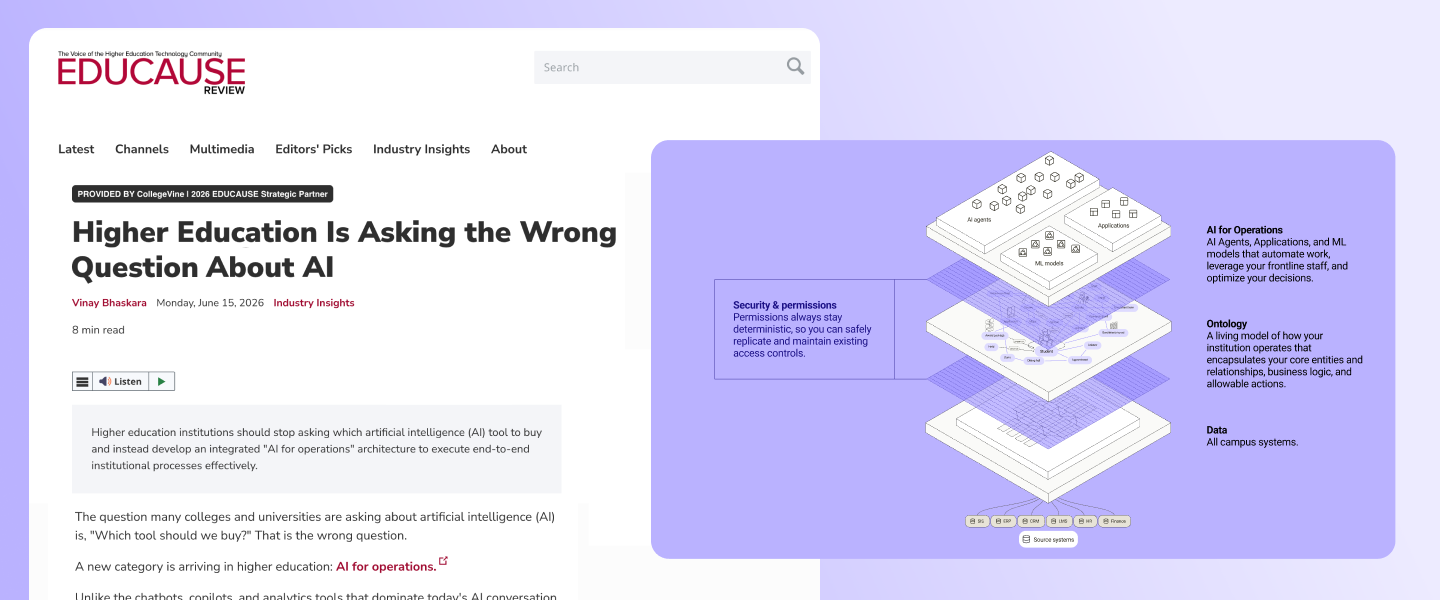
That same fragmentation shows up whenever a student's problem crosses more than one office: a request for housing and a meal plan can hide a financial aid problem, which forces a night job, which starts costing morning classes, and no single office sees the whole chain. NJIT is now working with CollegeVine to bring its data lake into one consolidated student record, so the next advisor who meets that student doesn't have to piece the story back together alone.
For campuses where students have no time to spare
Answering fast, and finally letting one office see what another already knows, removes a burden NJIT used to leave on students: carrying their own story from door to door.









.png)
.png)


.png)