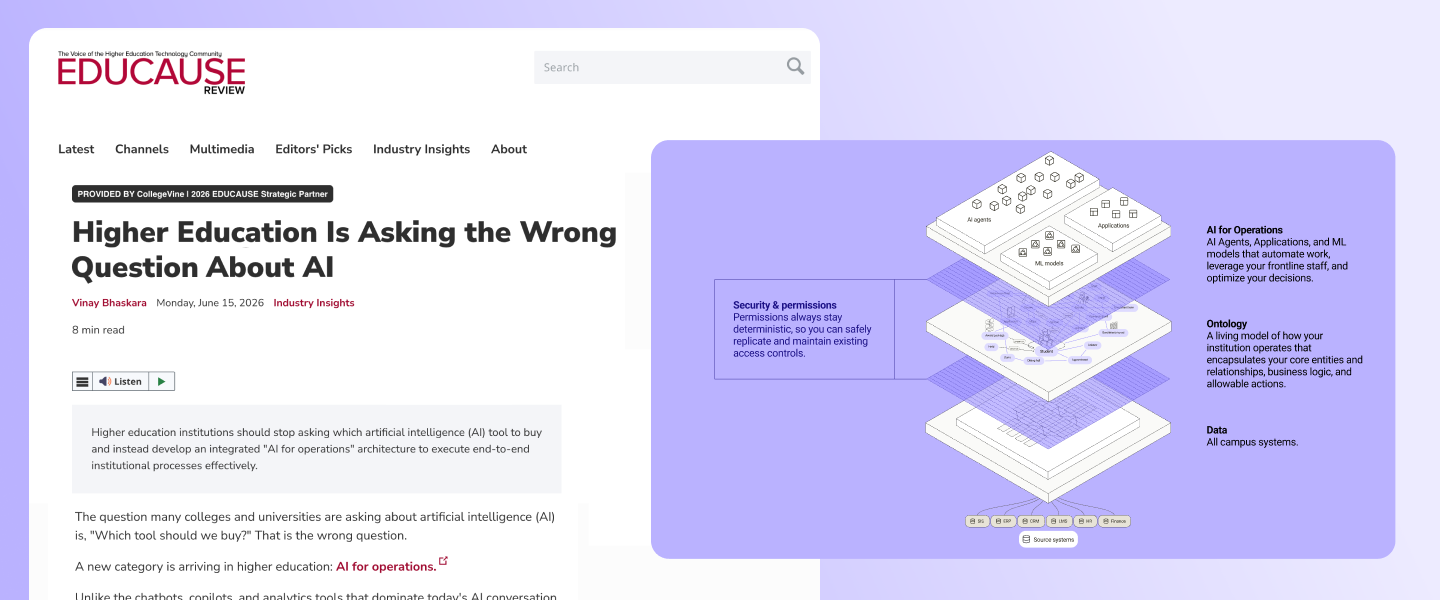
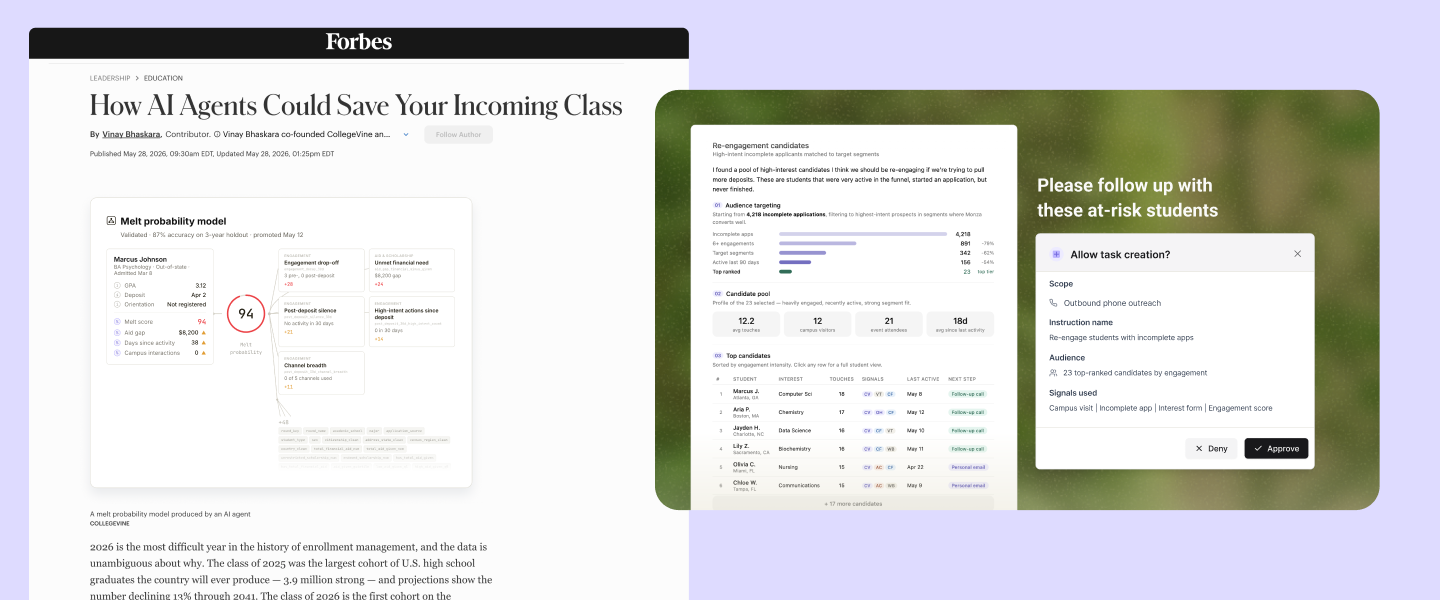
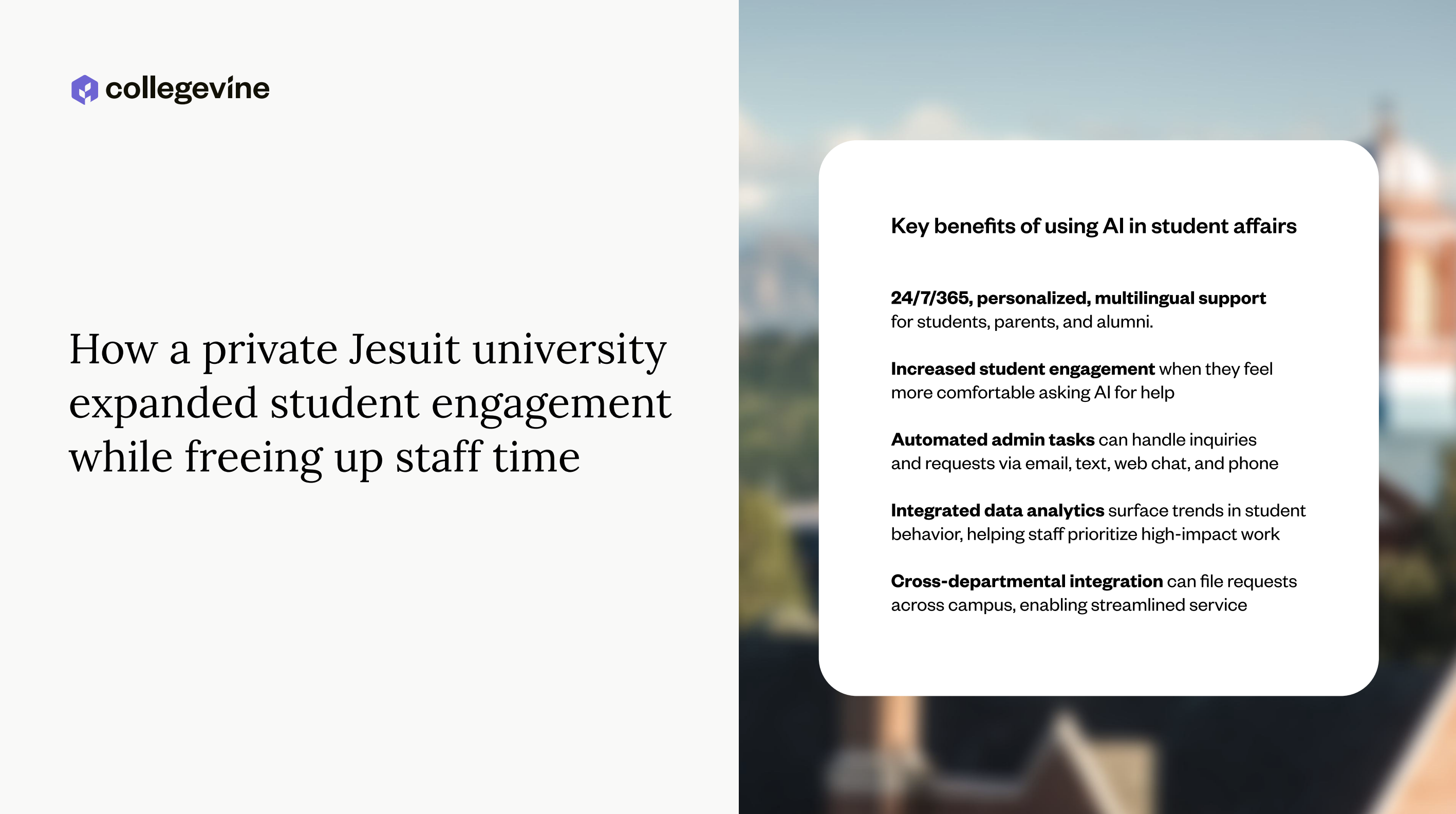
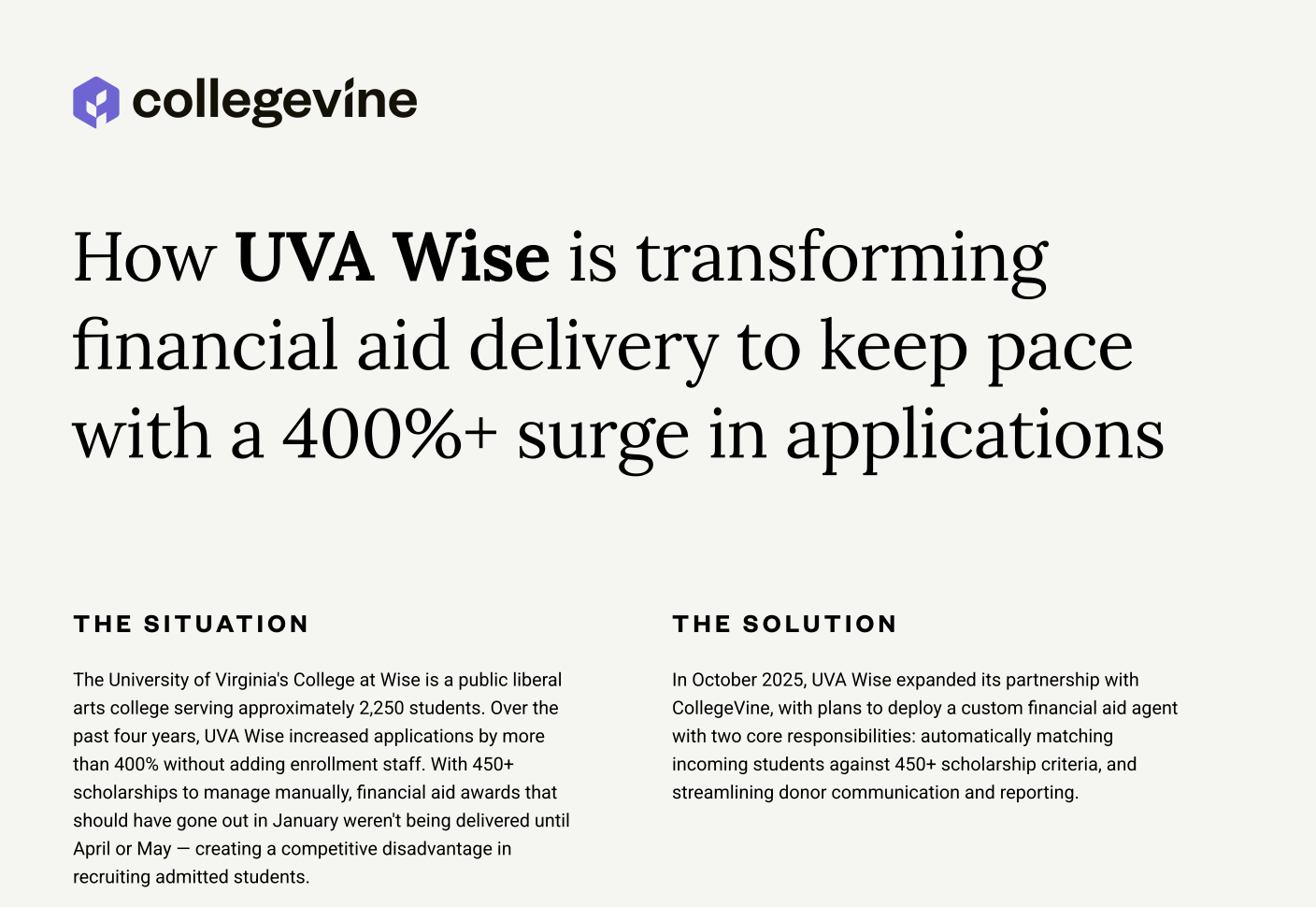
Most of the AI conversation in higher ed has centered on the classroom, but a smaller group of leaders is asking a different question: what happens when AI helps run the institution itself? AI in higher education operations means using AI agents to take on the administrative work that keeps a campus moving, like building course schedules, processing financial aid, and following up on compliance steps, which frees staff up to spend more time with students.
That question came up in a recent episode of Audacious Ideas, a podcast on leadership and decision-making hosted by Dr. Lillian Schumacher, president of Tiffin University, where she was joined by Zack Perkins, co-founder and CEO of CollegeVine. Here are the ideas that stood out for campus leaders.
What's the difference between AI for learning and AI for operations?
When people talk about AI in higher ed, they're usually talking about learning: what students can do with it, what faculty decide, and what institutional policy says. Zack pointed out that higher ed moved early on those questions, even though the jury's still out on where they land. Operations is a different story, because there's far less happening there, and as he put it, "the realm of using AI to change our operations is still so, so nascent."
From his conversations with university leaders, very few institutions have even 2% of their operations touching AI, apart from individual staff members using ChatGPT as a personal assistant. (If you want more on how CollegeVine thinks about this, see Higher education is asking the wrong question about AI.) So what would operational AI actually look like? Zack pointed to a few places across a campus:
- A registrar building better course schedules that factor in retention, persistence, and how buildings and faculty are allocated
- A financial aid process that moves faster and awards more equitably
- Finance and business operations, including supply chain and inventory management
He thinks the classroom work and the operations work should happen side by side, because the real risk is when a university figures out its future learning model and then can't deploy it. He said "the biggest tragedy to higher education would be if they solve that, they figure out what that model should be, but they can't implement it," whether that's because of institutional inertia or legacy software that can't handle the change.
Why should leaders focus on enduring problems instead of today's solutions?
According to Zack, leaders tend to pick the wrong problem to solve, either because it's too low-level or too local, or because it won't exist in the same form tomorrow. AI makes that especially easy to see. A workflow that once justified its own software tool can disappear the moment an agent handles the whole job, and then the next problem looks different anyway.
His answer is to anchor on the problems that don't change and stay ready to swap out the solution stack as often as needed. For a university, those problems are serving students and the community, keeping strong revenue-generating functions, and staying agile. CollegeVine keeps its own goal at that level on purpose. "I'm not saying I want this department in this subdivision to solve this one problem," Zack said, "because that problem is not going to exist a year from now depending on how we refactor that organization entirely."
He also made a point about the difference between operations and mission. "Your operation is not your mission. Your operation serves your mission," he said, and a university can be fully mission-driven while still running a tight operation. In his experience, the institutions that fall short of their mission are often the ones that tangle the two together.
What does a student-centered operating model look like?
Zack began with what a university feels like from a student's side. You might be dealing with something like 30 departments, with compliance steps you don't know about and requirements that depend on each other in ways you can't see, like taking a course at the wrong time and adding a semester to your graduation date. A one-stop office helps, he said, but it's still a lens on top of siloed departments and older processes that may not even need to exist.
That's why CollegeVine is working with partners to map the institutional logic behind degree pathways, including credit requirements, and turn it into software. Once that's in place, leaders can start asking better questions, like whether a pathway can be shortened, which choke-point courses need more sections, and which compliance steps are just getting in the way. (Zack talked about the shift toward this kind of deployment in his Vineyard 2026 keynote.)
Lillian shared how this plays out at Tiffin with Dragon Pathways, where students are placed on a path from the moment recruitment begins and get support through persistence and completion with help customized to them. Tiffin has been building the model for four years and has seen results in persistence and completion, she said, and she sees AI as a way to zero in on the parts that move the needle. The two organizations are now exploring how AI can strengthen the model even further.
Zack added that guiding a journey doesn't mean putting everyone on the same one. Dragon Pathways gives students plenty of options, and the structure still helps them avoid mistakes they don't need to make while they explore, which is a big contrast with universities that stay an open playground and expect students to figure it out alone. On top of that, AI can give leaders "an amazing data feedback loop" on how pathways are performing and where they can get better.
Can operational AI improve margin without layoffs?
Zack doesn't buy the projections that say many universities will run out of money. In his view, a lot of those projections assume operating costs will keep growing at the same pace as in past decades, when part of that growth tracked enrollment growth, and with enrollment likely to flatline, he called that assumption faulty.
10 to 15 points of margin. Zack's estimate of what a university could free up by rethinking its operating model, including where AI can run an office and which functions to centralize, claiming most of that margin would come from somewhere other than headcount. His examples come straight from what he sees in institutional data:
- A compliance issue that takes an office 40 days to resolve, when the data shows students drop out if it isn't handled within two weeks
- Classroom allocation that pushes sections into time slots that shut out adult learners with childcare pickup
- Patterns that look unrelated until the data connects them, like HVAC sensor data at a larger university showing colder buildings tied to lower attendance, which traced through to lower pass rates and persistence
"There are so many buckets of just odd inefficiency that have nothing to do with headcount," Zack said. He was upfront that some jobs won't need to exist, though he doesn't expect that to be the majority of the change.
How can AI agents run operations safely?
It's a fair question, since AI can make mistakes, and Zack walked through how CollegeVine approaches it. The approach plugs into a university's existing data systems and builds an operating model from them, covering the business operations in each department and the rules that govern them. From there, leaders get a view of where processes are breaking down and how many students are affected, all the way down to the net tuition revenue lost each semester, and AI agents can then act on those processes with guardrails.
The key is that policy decisions stay in deterministic logic. An agent doesn't decide whether a student gets a particular aid package or whether an applicant is admitted. "The agent isn't deciding what package to give the student. It's looking at what packages are allowed to be given," Zack said, so deterministic software answers that question first and the agent carries out the step afterward.
Where should leaders start with AI in operations?
Zack had two pieces of advice. The first is to get close to the work. He spends his own time on sales calls, partner calls, hiring interviews, and shipping product, since that's how he learns how things actually run. He suggested senior university leaders do the same by packaging a financial aid award for a student, sitting in on admissions committee reading, or trying to build next semester's schedule with the registrar. Rather than asking an AI to tell you what's happening, he said, dig in and look for yourself.
The second is to hold two timelines at once. Some leaders start a one-year committee to plan for AI before doing anything, and by the time it wraps up, the landscape has changed. Others roll out the first thing they see, which he called dangerous. The leaders he sees getting this right keep the long-term vision while also having "the pragmatism to say let's cut this down into the thing that we can get started with this month," and then they evaluate as they go.
He encouraged leaders to see this moment as an opening, since what an institution does between 2024 and 2028 is what its success will later be traced back to.
Why is Zack optimistic about higher education?
He gave three reasons. The first is that higher ed is a bundle of things, including workforce preparation, credentialing, a soft landing between adolescence and adulthood, research, and support for local communities. Plenty of venture-backed alternatives over the past 20 years haven't caught on, and even if AI handles 80% of tactical work, he expects roughly as many people to attend college as do today. The second is that changes to the operating model can make institutions financially sustainable, and the third is that he doesn't expect a job apocalypse.
Looking ahead, he predicts a more diverse set of institutions, with smaller ones that do certain things really well able to compete. Over the next 10 years, he expects a more fluid learner journey, where people come back to the university over time and institutions work more closely with employers. If you want more examples of where operational AI is already running, check out 6 AI use cases gaining traction in higher ed operations.










.png)
.png)


.png)